
Start a Sparks Resident Lookup
No single record identifies every Sparks resident. A parcel card can connect a name to an owner or trustee and a situs address, while a recorded deed supplies a dated party relationship. A court result can distinguish a name variant when its court, case number, role, and date fit the same person. Voter tools have tighter boundaries: Washoe's public map supplies district information for an address, and an elections-file request is a different route with protected fields removed. Historical directories, newspapers, probate records, and obituaries are most useful for a past connection.
| Record | What It Confirms | Where | Access |
|---|---|---|---|
| Assessor parcel card | Owner or trustee, situs, mailing address, APN, transfers | Washoe Assessor CAMA | Free public property search |
| Recorded document | Grantor or grantee relationship, document date and number | Washoe Recorder self-service | Index online from November 1991; older books or microfiche |
| Voter information | Address district assignments and a person's own registration route | Washoe voter address lookup | Address map is public; protected fields stay withheld |
| Court case | Case number, party role, hearing or filing lead | Sparks Justice Court | Online search plus clerk and counter options |
| Vital record | Birth, death, marriage, or divorce event | Nevada Vital Records | Eligibility and confidentiality rules apply |
For an owner question, begin with CAMA. For a prior deed, carry the owner name and approximate transfer year to the Recorder because that index does not search by address, APN, or legal description. For a past household, use a dated directory or obituary alongside a court or deed record. That division keeps a resident lookup focused on what each custodian actually holds.
Match Names in a Sparks Lookup
Normalize the name before opening several portals. The Recorder indexes parties as last name, a space, then first name, with no comma. Middle initials, suffixes, former surnames, spouse names, and trust or entity spellings can all matter. Preserve each source's spelling in a search note. A near match is only a lead until two independent identifiers agree, such as the same name plus a parcel's legal description, a related person, a court number, or a dated newspaper citation.
The Assessor supports All, APN, Owner, Address, and NBC modes. Its Owner field accepts the percent sign as a wildcard, so a partial form can surface a spelling variant. Results expose APN, situs, owner, and last document date; the parcel card then separates the situs from the mailing address. A mailing address may be outside Sparks and does not prove the owner is the person living at the parcel. This distinction prevents a resident lookup from turning tax correspondence into a residence claim.
Use Sparks Court Lookup Results
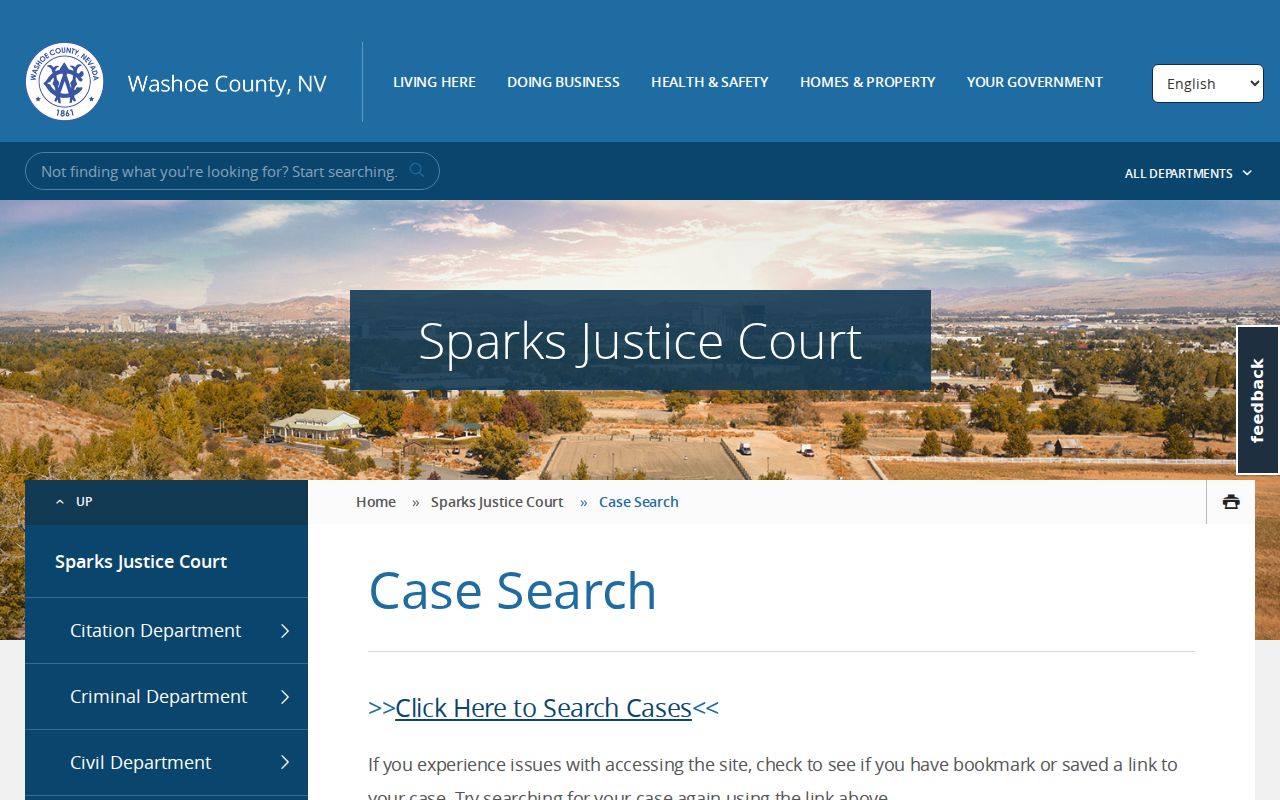
Sparks Justice Court handles limited-jurisdiction criminal, citation, and civil matters. Its official landing page links to online services, but the inspected form did not expose every live field. The court displays options for finding a case, payments, and e-filing, and county guidance states that a citation may be searched by name or citation number. If the online service is unavailable, avoid repeated refreshes because the court warns that unusual automated activity can trigger a temporary block. Call the clerk or use the counter instead.
The Sparks Justice Court case-search entry is shown in the official capture below. It establishes the court's search route, not a promise that every historical case is available online. A name result needs a role, date, and case number before it can help verify a resident.
Use the court's current contact route for a record that requires a file, an archived-case check, or a copy request. Sparks Justice Court is at 1675 E. Prater Way, Suite 107, and its published hours are Monday through Thursday, 7 a.m. to 5:30 p.m.
A public calendar sample shows why the distinction matters. It can display a hearing time, a case number such as the court's stated format, a defendant name, a hearing label, and a Zoom-session label. The court says calendar lists are updated daily and may change. That sample is not a full docket and does not supply a disposition, complaint text, address, date of birth, document image, or sealed material.
| Calendar field | What it supplies |
|---|---|
| Hearing time | The scheduled time shown on the public calendar |
| Case number | The court identifier needed when asking the clerk about a file |
| Defendant name | A displayed surname and given name, sometimes with middle name or suffix |
| Hearing label | Examples include arraignment, plea, sentencing, pre-trial conference, or traffic court |
| Zoom session | The listed session or room label, not a case disposition |
For a federal filing, use PACER to search the District of Nevada or the national case locator after creating an account. It is a separate federal route, not an extension of the Sparks court system.
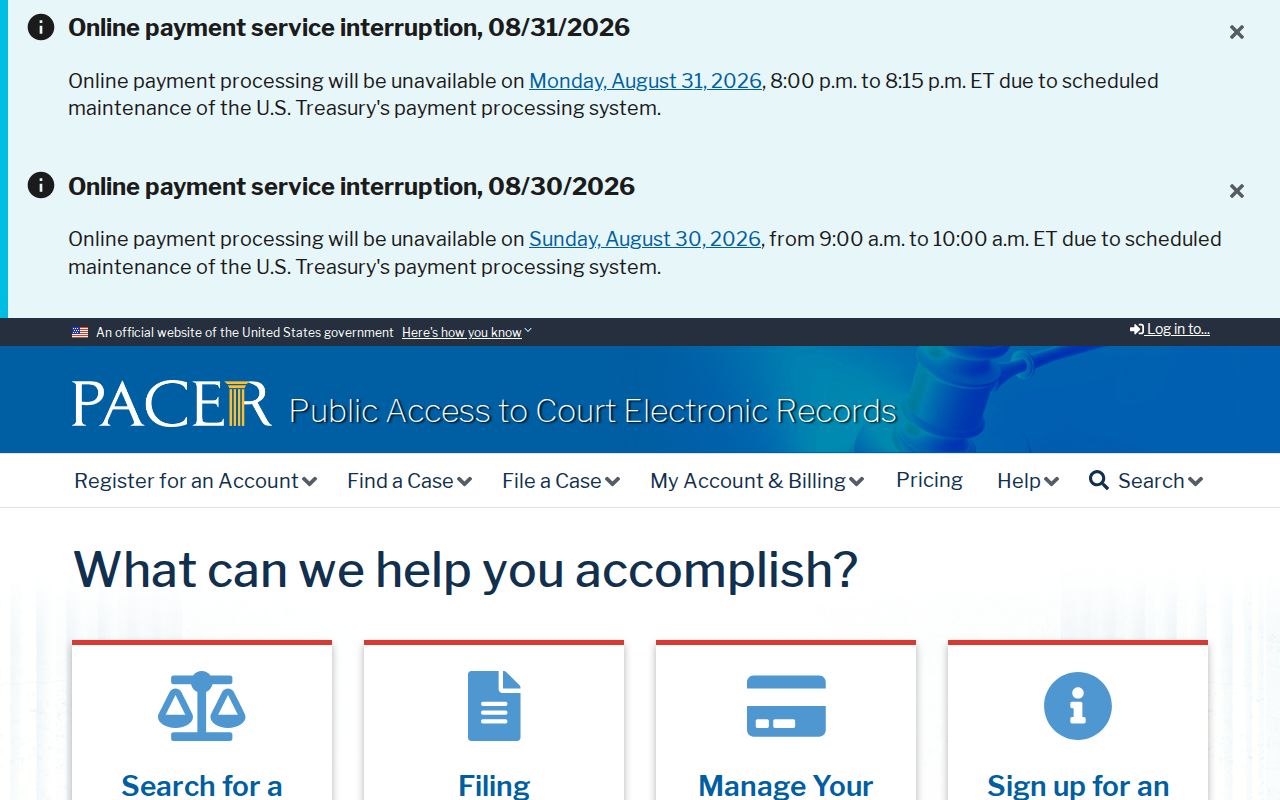
PACER charges $0.10 per page, while electronic viewing at the federal courthouse terminal is available without charge during published weekday terminal hours. Sealed material remains unavailable through either access route.
Verify a Sparks Resident Across Records
A sound resident lookup asks one question at a time and compares the answer with a second source. Property, court, vital, and historical records use different dates and definitions, so agreement on a name alone is weak. The steps below create a short, reproducible trail without treating any one result as a complete profile.
- Use the Assessor's owner or address search to anchor the person to an APN, situs, transfer date, or legal description.
- Search the Recorder by the exact party name and an approximate year. Match the returned document to the parcel by its parties, date, and legal description.
- Search the appropriate court by name variant. Compare the court, case number, filing or hearing date, and party role before treating the result as the same person.
- Use a vital, obituary, directory, or probate source only for the narrower family or historical question it can answer. Request a certified record from its custodian when a certified copy is required.
- Docket
- A court's running case record. A calendar row can point to a docket but is not the whole case file.
- Index and image
- An index lists searchable record details; an image is the document view. Washoe's real-estate index begins in November 1991 and online images begin August 16, 1999.
- Certified copy
- A copy issued by the custodian with the certification required for an official purpose. It is different from a free online view or an unofficial copy.
Second Judicial District Court is the broader county court route for felony, gross-misdemeanor, larger civil, family, and juvenile matters. Its online search and courthouse terminal can be useful, but juvenile, adoption, sealed, protected-family, and expunged material remains restricted. Federal questions belong in PACER, where the District of Nevada ECF system lists a November 7, 2005 go-live date and electronic pages carry the published per-page charge.
Note: A case match should be verified with the court and its case number before any identity conclusion is made.
Open Sparks Vital Record Doors
Birth and death records are not open name directories. The Nevada Office of Vital Records holds Nevada birth and death certificates from July 1, 1911 forward, and Washoe County Health District or Northern Nevada Public Health is the local issuing route for Washoe events. Under NRS 440.170, birth information opens after 125 years and death information after 50 years, subject to other law. Before those periods, NRS 440.650 and NAC 440.070 limit certified copies to people with a qualifying direct relationship, legal relationship, or legal-process need.
Applicants can use the state office's mail or in-person route, and the state identifies VitalChek as its online ordering channel. A certified birth copy costs $25; a birth or death verification costs $10, including when no record is found. The certificate application requires identifying details, relationship or legal-need information, payment, photo identification, and proof where required. Pre-1911 events move to county recorder or local historical sources rather than the modern state certificate process.
Marriage and divorce have different doors. Washoe County holds the marriage route, while a divorce decree comes from the court where it was granted. When the county or date is unknown, the state can search marriage or divorce verifications from 1968 through September 2005 for $10 per name. That verification is not a certified copy.
Keep a Sparks Voter Lookup Narrow
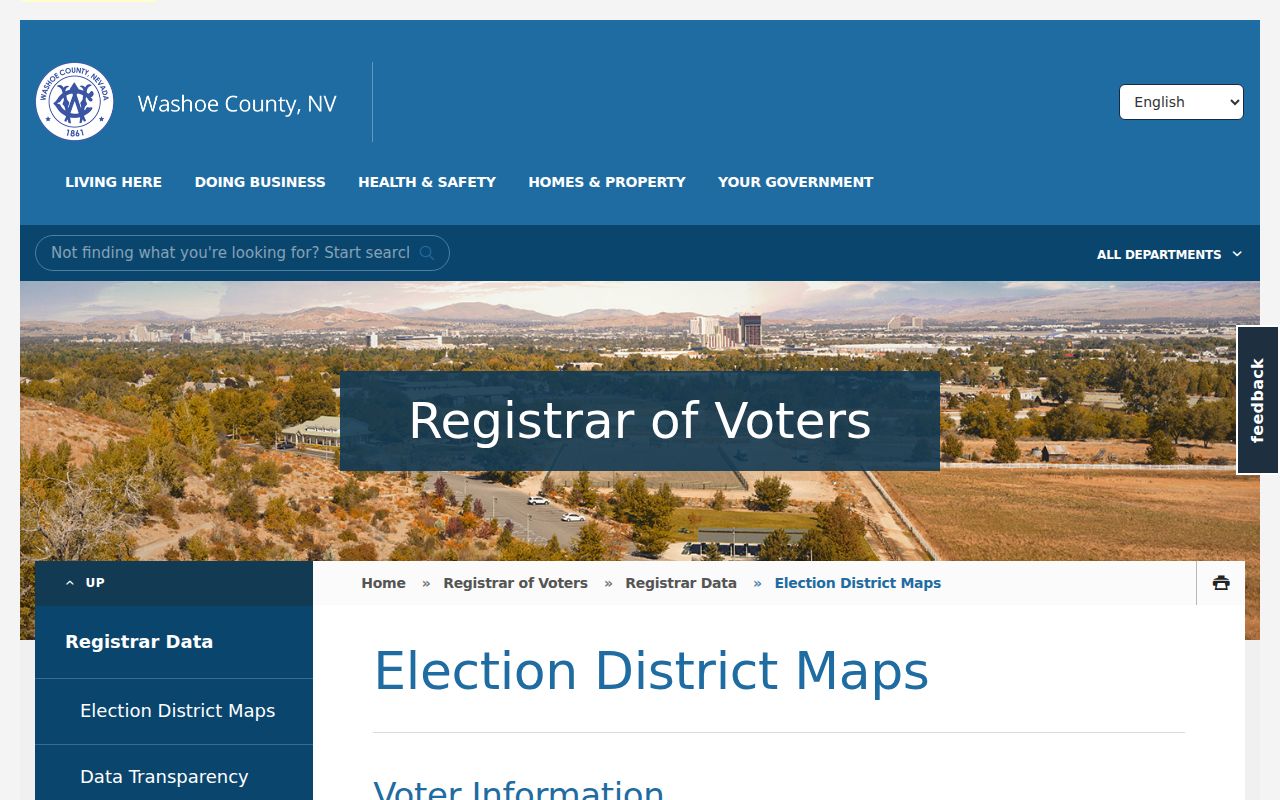
Washoe's public voter map is an address-to-district tool. Its visible field asks for a street address and returns political geography such as precinct, Senate, Assembly, school, commission, ward, township, and improvement districts. It does not return a list of people at the address. Nevada Voter Services supplies the separate state registration-check route, but its live identity fields were not visible in the inspected official text.
The Washoe address lookup capture shows the district-oriented form. That public result is useful for confirming civic geography around a known address, not for building a name list.
A separate Nevada Voter Services capture shows the state entry point for voter services. Use it for the official registration path rather than interpreting a district map as a personal record.
NRS 293.558 withholds Social Security numbers, driver's-license or identification numbers, voting email, and requested address or phone fields. Ordinary confidential-voter status leaves the name visible while shielding address and phone; CAP voters can receive stronger protection under NRS 293.5002. The Registrar's written-request route is the fallback for a lawful, specific voter-file request, but the current fee and format were not published in the inspected source.
Continue a Sparks Resident Lookup Offline
When a portal does not answer the question, use the custodian's documented alternative rather than guessing from an incomplete result. The Recorder's web index begins in November 1991 and its images begin August 16, 1999. Earlier ownership work continues in books or microfiche at the Recorder counter. The Recorder does not provide staff searching, so arrive with party names and approximate years. For older household evidence, Downtown Reno Library staff can search directories, telephone books, and obituary citations when given a name, date, and address fragment; UNR Special Collections supplies finding aids and local materials.
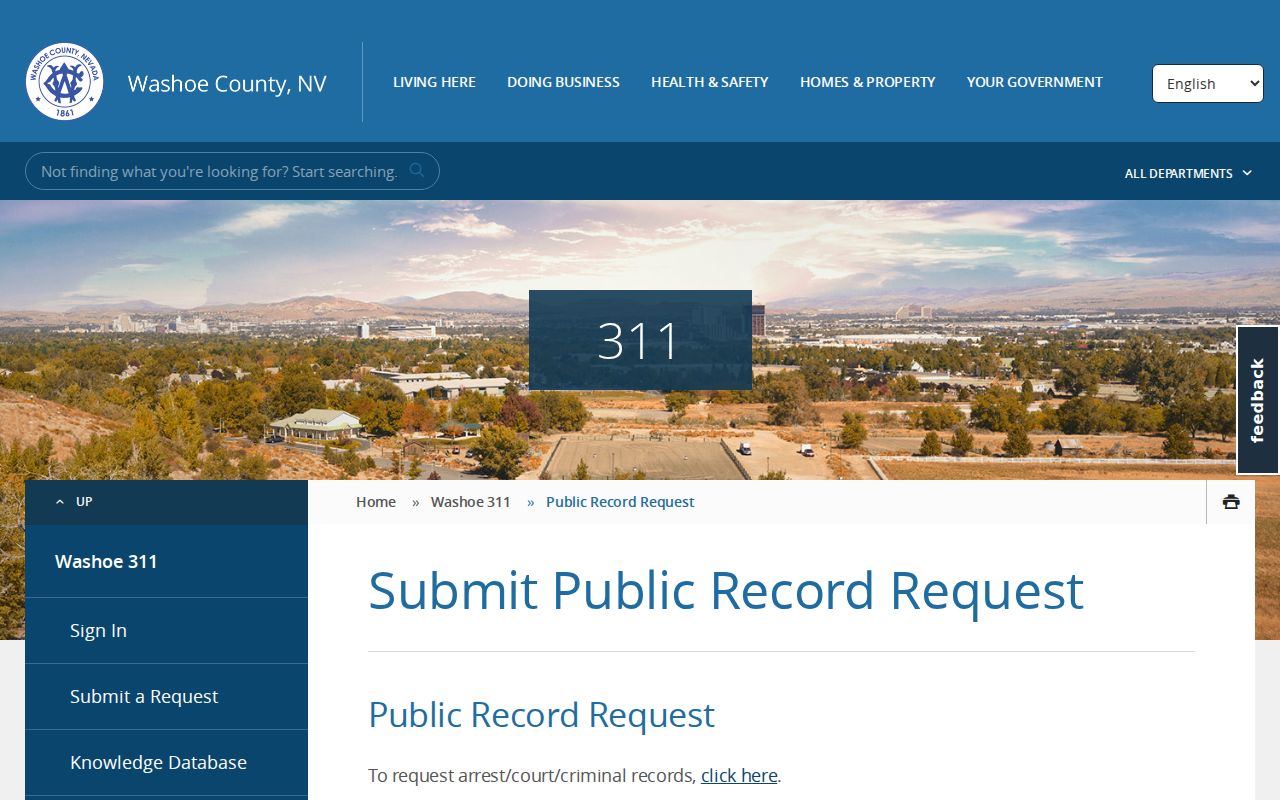
Washoe's public-record request route directs general requests and points specialized marriage and vital requests to their responsible offices. The official request screen is pictured below. A useful request identifies an existing record, date range, agency, and any case number, APN, or document number. Nevada Public Records Act, NRS Chapter 239, presumes inspection and copying unless a separate law makes a record confidential. NRS 239.0107 requires a response by the end of the fifth business day, which may be a production, withholding explanation, availability notice, or time estimate.
Mail, email, fax, hand delivery, and the county's online route are documented request channels. Inspecting in person can reduce copy charges. A custodian may redact protected fields while releasing the rest, and a partial response is not proof that the underlying record is wrong.
Trace a Sparks Resident Lead
For an heir or former household, probate filings, obituaries, Recorder transfers, directories, and census entries can form a sequence. An estate representative, deed grantee, or obituary relative is a dated lead, not evidence of a current address. The strongest approach is to compare a probate or court reference with an obituary date and then follow the relevant deed transfer. UNR city directories start in 1900, while library shelves and microfilm can supply later local context.
Sparks history makes place names important. The city grew from the Southern Pacific relocation in 1904 and incorporated in 1905, so an early household can appear under Wadsworth, East Reno, Glendale, or Harriman instead of the settled Sparks name. The library's Sparks Tribune microfilm covers 1977 through 2007, and Downtown Reno Library holds a Reno obituary index for mid-1962 through September 2007. Those sources can establish dates and family connections, but should be checked against the original paper, court file, or custodian record.
Protect a Sparks Resident Lookup
Public access has firm boundaries. Nevada CAP gives qualifying survivors a fictitious address and confidential mail forwarding, and confidential-voter rules can shield address and phone information. Recorder confidentiality statutes cover certain personal information, while an APN is not treated as the same kind of protected identifier. Court-sealed material, protected vital records, driver's-license data, utility customer information, and private association rosters are not open substitutes when an ordinary search does not return a person.
Official records and commercial data-broker tools are not equal. A custodian's result has a stated source and date, while a commercial category may combine old public fragments, marketing data, and user-supplied information. Such results can be stale or join two people with similar names. Correct a source record with the office that controls it; a category-level opt-out from a commercial listing does not alter the original county, court, library, or newspaper record.